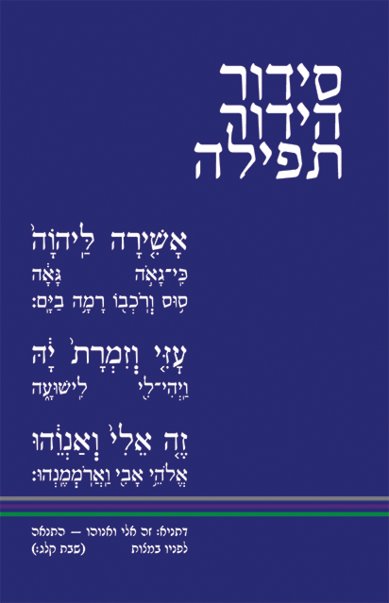
Siddur Hiddur Tefillah
A prayer book to beautify our prayers
The goal of this project
This started off as a personal project, to create a siddur that would help me to make my tefillot more accurate and more beautiful. Several friends have encouraged me to make it available to others, and the price of short-run printing has now decreased to the point where that's practical.
The features of this siddur
- To assist in correct pronounciation, the siddur distinguishes sh'va na from sh'va nach, and qamatz katan from qamatz stam. Also, the shape of the letter 'sin' differs slightly from that of 'shin', and vav degusha differs slightly from shuruk.
- To help in using the correct nusach, musical "cues" are placed throughout the siddur.
- Additional musical "cues" serve as reminders of melodies for various special points in the liturgy. When possible, the composers of these melodies are given proper credit for their work
- The layout is designed to accentuate proper phrasing of the words: in part by including the taamei himiqra/taamei emet on pesukim, and in part by careful selection of line and page breaks.
- The layout also provides visual beauty to inspire deeper kavanah.
- To reduce the weight of the siddur, the tefillot are organized in a non-standard configuration. (See next section.)
The organization of this siddur
The siddur is organized to reduce unnecessary redunancy. For example, a traditional siddur has shacharit l'chol, and then a separate section for shacharit l'Shabbat v'Yom Tov --- yet the latter requires a second copy of Sh'ma uvirchoteha from shacharit l'chol. My siddur, on the other hand, simply has shacharit, with appropriate divisi parts where needed. Similarly, I have a single Amidah with the necessary variations in the middle berachot
In the other direction, while a traditional siddur does not require a lot of "jumps," when it does require them, they tend to be "far". This siddur goes in the other direction --- there are often jumps of one or two pages, but rarely are there significant jumps.
To accommodate this condensed organization, color is used to distinguish chol (black) from Shabbat (purple = royalty for Shabbat ha-Malka), Yom Tov (green = agriculture), Shabbat and Yom Tov (blue = the common primary color of purple and green). Things that are said sometimes or by some traditions are in grey.
Please see the user's guide for a more detailed explanation.
Gender-specific editions
There are two editions of the siddur. They differ in one regard which is both slight and very significant. In about a dozen places, the text of our liturgy is gendered. Siddurim always give both options, but invariably the text for men is first.
To address this imbalance, I am providing two variations on my siddur. The version "Az Yashir Moshe" has the text said by men followed by the text said by women; the version "Va-ta'an Lahem Miriam" has the text said by women followed by the text said by men.
This is not a "women's siddur" in the sense that others have produced: The content is complete, and there are no patronizing commentaries. The only difference is that in the women's edition, "Modah Ani" precedes "Modeh Ani", and similarly for all other cases where there's a gender-specific textual variant.
FAQs
Several excellent questions have come in since I launched this page --- too many to be included here, in fact, so they are on an FAQ page.
Are you interested?
Copies are now available via print-on-demand at Lulu.com for $34.40. They sometimes have some sales or coupon codes good for 10% or 15% off, or free shipping.
BUY "Az Yashir Moshe" HERE (edition with men's texts first)
BUY "Va'Ta'an Lahem Miriam" HERE (edition with women's texts first)
Version history
Because this is print-on-demand, I am using a software-style "version number" to keep track of changes.
| Version | Date released | Description |
|---|---|---|
| 1.0.0 | 6 July 2015 | First general release |
| 1.0.1 | Early Aug 2015 (In process) | Fix colors throughout |